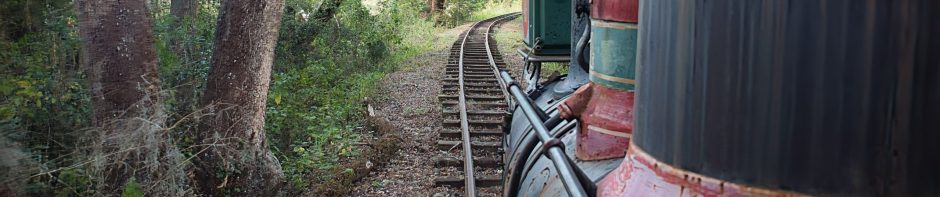
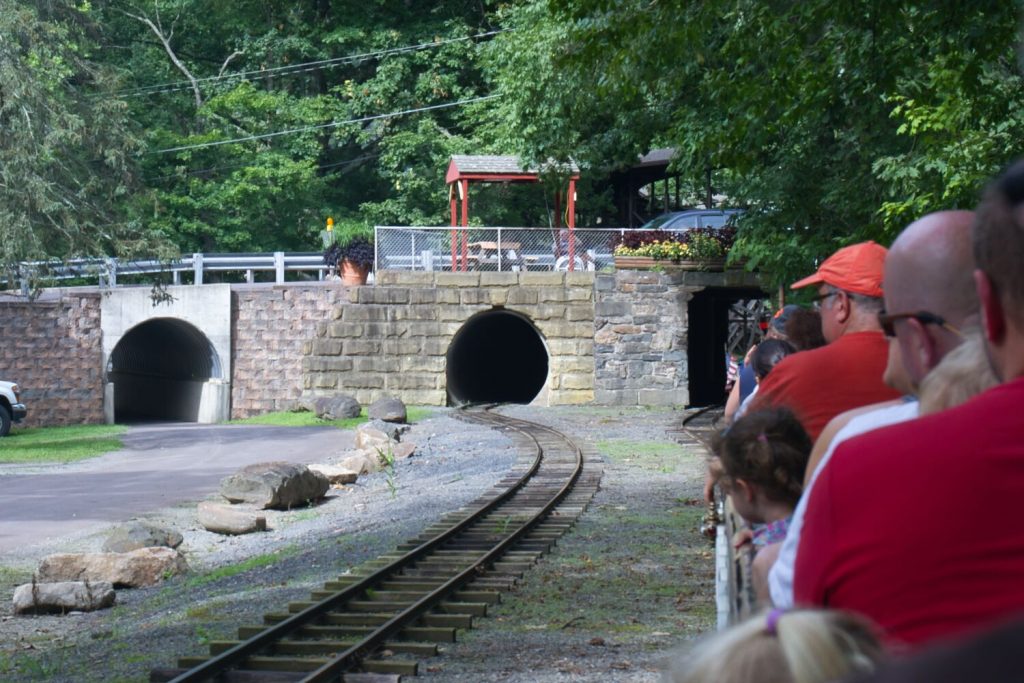
“Okay, everyone, there’s a tunnel up ahead. As we go through it, make the sound of your favorite animal!”. The unique acoustics of the tunnel allows for the roars, growls, and squawks to echo in all directions. Just as a train ride is a staple of numerous amusement parks, the tunnel is often a staple of many such train rides.
Trains and tunnels often go hand in hand. Even in cartoons, when Wile E. Coyote paints a tunnel into a rock face to catch the Roadrunner only for the Roadrunner to run straight through it and when Coyote enters to investigate, a train comes roaring out of it. Compared to road vehicles, trains with their larger size, wider turning radius, and often higher speeds, often require tunnels to get to their destination efficiently. In addition, steel wheels do not offer as much traction on steep inclines, although there are ways to drive trains over mountains via the use of rack/cog systems (and in my home country of New Zealand, the earlier Fell system, which used a third rail that the locomotives and brake vans would grip onto using a special set of wheels and/or brake shoes). These systems, however, are often slow, and require specialized locomotives and other equipment to make the climb, as well as for the journey back down (in the early days, train braking was more primitive and not as fail-safe as modern systems). Extra labour was also required for the additional shunting/switching to attach and detach the additional equipment. Many such systems, including the Rimutaka Incline (which did use the Fell system), later closed when building tunnels became more practical.
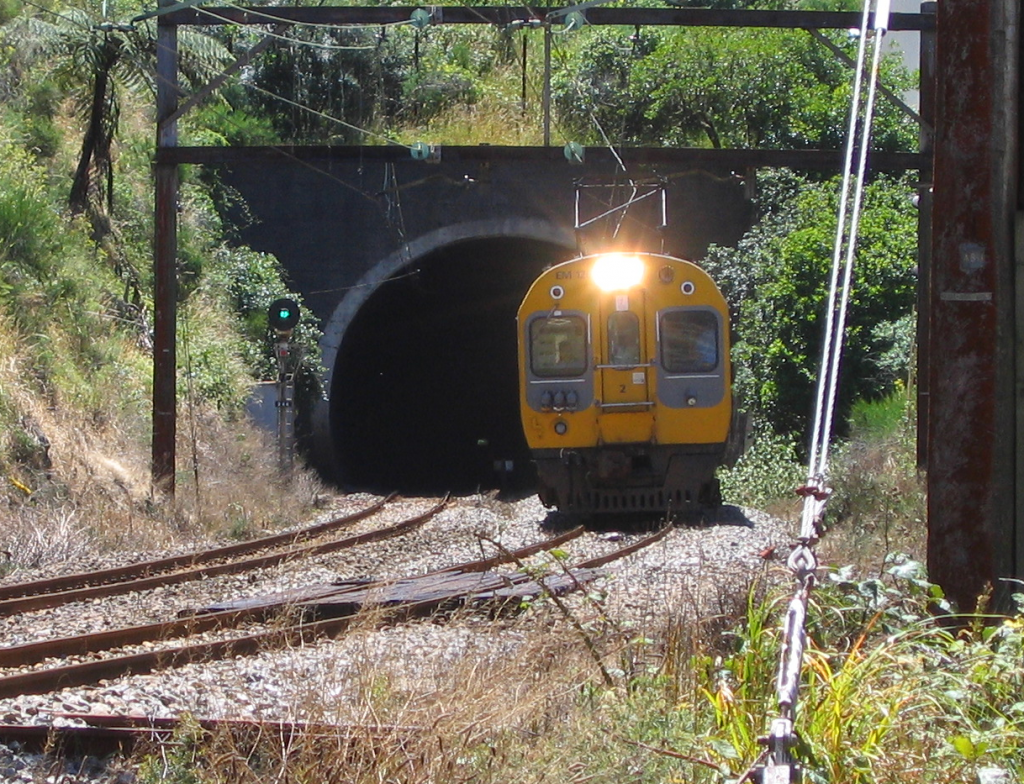

As a young child, we often travelled into the city, and while we usually did the 30 km (19 mile) journey by car, it was always a treat to take the train instead. For someone on the spectrum, it was a sensory experience – the clickety-clack as the wheels traversed the gaps in the rails, the hum of the electric traction motors as they changed pitch as the train sped up or slowed down, and then there were the tunnels. One moment we’re out in the daylight and then with a whoosh everything changes – the blackness outside the windows, the reverb of the train itself, and the rushing of air going by. As a child with intense fears and phobias, a tunnel might be dark and scary, but we were safely in the train with the lights on, and I was not afraid. Four kilometers we later burst back into daylight again, but only for a brief moment as we cross over State Highway 1 and enter the second tunnel, though this one is a bit shorter – just over 1 km long, but no less exciting. After we emerge from the second tunnel, we traverse the final leg of our journey to Wellington Railway Station.
My grandfather caught wind of this fascination I had with trains and tunnels, and I have memories of building “tunnels” (actually just archways) with him out of my mother’s old building blocks when we went to visit. Being handy with wood, he also built a toy train with a tunnel for it to go through out of several blocks of wood. At school, I often spent lunch periods playing in the sandbox digging tunnels of my own – sometimes with the other outcast kids.
As with so many other childhood interests, it gave way to other things when my family moved to another city (one without as many trains or tunnels), and later to a city that did have a large road tunnel. Though the road tunnel was impressive, it did not have the same excitement as the sights and sounds of a train tunnel.
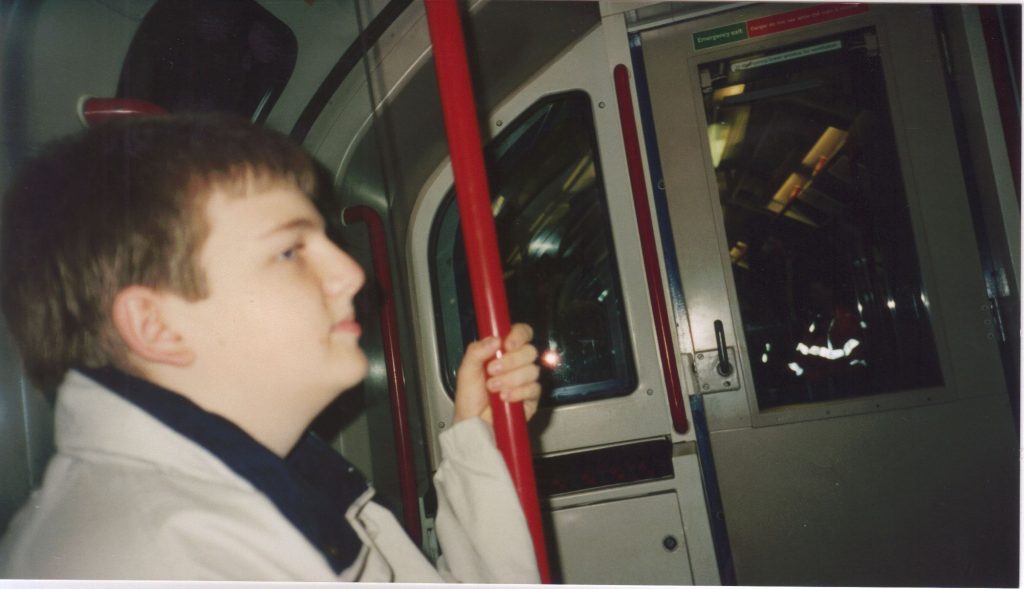
In later years I still did get to experience plenty of tunnels, despite living in Florida where the highest mountain is at Disney World. In 1999, my brother and I went to visit family in London for the first time. We took a boat ride down the Thames and hailed a black cab. Of course, we also rode plenty of trains (including the Underground, which is not just a single tunnel, but a “series of tubes”). In addition, we took a day trip to Paris. The highlight of that day was not the Arc De Triumph, the Eiffel Tower, or even the rubber-tired Metro trains, but taking the Eurostar through the Channel Tunnel – like the 747 and the Queen Mary, this was something I had previously read about in books and finally got to experience in real life. Zooming under the English Channel at 100 mph (160 km/h) through a modern marvel of engineering was something that was once believed unfeasible a century prior.